






Annular Solar Eclipse of February 17, 2026:
On February 17, 2026, an annular solar eclipse will occur. Unfortunately for observers in Tunisia, this event will not be visible from North Africa. The eclipse will be confined to the Southern Hemisphere, offering a rare viewing opportunity only to specific regions of the globe.
Visibility Regions:
Partial eclipse visible from: southern Argentina and Chile, parts of southern Africa, and a portion of the Antarctic continent.
Annular eclipse: visible exclusively from Antarctica.
The moment of greatest eclipse will occur on Tuesday, February 17, 2026, at 12:11 Terrestrial Dynamic Time.
This peak occurs 6.8 days after the Moon reaches apogee (its farthest point from Earth), a factor that slightly affects the appearance of the eclipse. At that time, the Sun will be located in the constellation Aquarius. The Moon will be near its ascending node, a configuration that explains why the eclipse is visible only from limited regions.
Eclipse series:
This eclipse belongs to Saros series 121, a cyclic family of eclipses repeating approximately every 18 years. It is the 61st eclipse out of 71 in this specific series.
Astronomical phenomena often occur in pairs. Two weeks after this solar eclipse, on March 3, 2026, a total lunar eclipse will take place. Both events belong to the same eclipse season, a period during which the Sun–Earth–Moon geometry allows multiple eclipses to occur close in time.
| Eclipse phases | Local time |
|---|---|
|
Start of partial eclipse (P1) |
09:56:28 |
|
Start of annularity (O1) |
11:43:00 |
|
Greatest eclipse (M) |
12:11:52 |
|
End of annularity (O4) |
12:41:23 |
|
End of partial eclipse (P4) |
14:27:41 |
| Eclipse data |
|---|
| Magnitude = 0.96418 |
| Duration of annular phase = 00:58:23.3 |
| Total eclipse duration = 04:31:13.0 |
| Earth radius = 6378.137 km |
| Sun radius = 695700 km |
| UT1 − TT = −69.109 s |
Total Lunar Eclipse of March 3, 2026:
Key date and time
The eclipse will reach its maximum on Tuesday, March 3, 2026, at 12:33 local time. At that moment, the Moon—located in the constellation Leo—will be completely immersed in Earth’s shadow.
Visibility regions
The eclipse will be observable from:
-
Eastern Asia
-
Australia
-
The entire Pacific Ocean
-
The Americas
A detailed visibility map is available and can be enlarged by clicking on it.
Astronomical characteristics
-
The eclipse occurs 6.5 days after lunar perigee, when the Moon is closest to Earth.
-
It belongs to Saros series 133 and is the 27th eclipse out of 71 in that series.
-
All eclipses in this series occur at the Moon’s descending node, with a gradual northward shift from one event to the next.
Celestial context
This total lunar eclipse is preceded two weeks earlier by an annular solar eclipse on February 17, 2026, forming a paired set of eclipses within the same lunation.
| Eclipse phases | Local time |
|---|---|
|
Penumbral entry (P1) |
09:44 |
|
Umbral entry (O1) |
10:50 |
|
Start of totality (T1) |
12:04 |
|
Greatest eclipse (M) |
12:33 |
|
End of totality (T2) |
13:02 |
|
Umbral exit (O2) |
14:17 |
|
Penumbral exit (P2) |
15:23 |
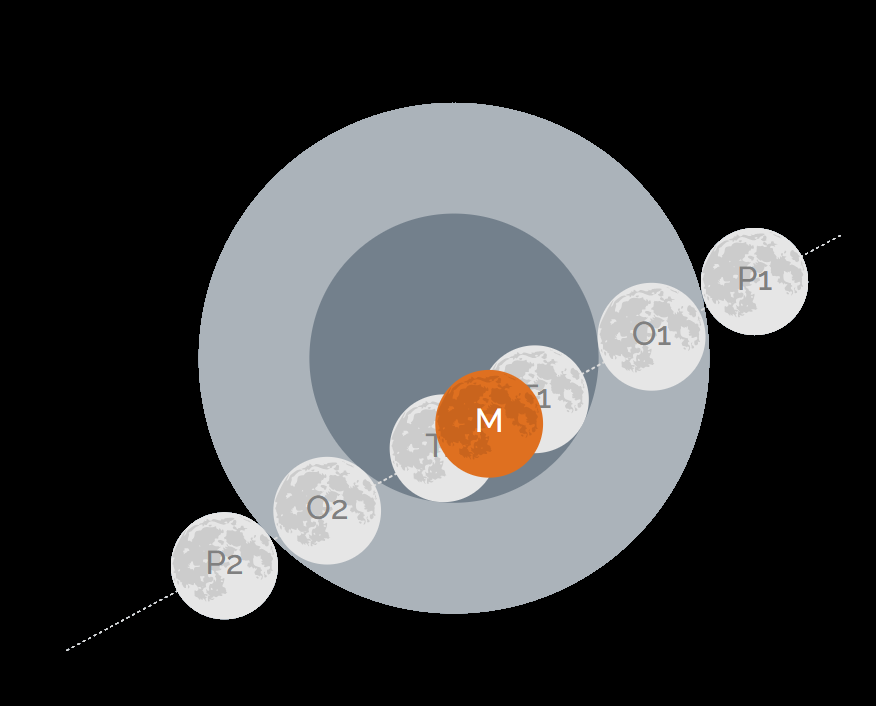
| Lunar eclipse data |
|---|
| Magnitude = 1.151 |
| Umbral radius = 0.6985° |
| Penumbral radius = 1.23607° |
| Totality duration = 00:58:23 |
| Partial phase duration = 03:27:14 |
| Penumbral phase duration = 05:38:40 |
| UT1 − TT = −69.113 s |
Total Solar Eclipse of August 12, 2026:
The total solar eclipse of August 12, 2026, will be visible from the following regions:
Partial eclipse: northern North America, West Africa, Europe
Total eclipse: Arctic, Greenland, Iceland, Spain
The map below shows the geographic regions where the eclipse will be visible.
The moment of greatest eclipse occurs on August 12, 2026, at 18:46 local time. This is 2.3 days after the Moon reaches perigee. During the eclipse, the Sun will be located in the constellation Leo.
This eclipse belongs to Saros series 126 and is the 48th of 72 eclipses in that series. All eclipses in this series occur at the Moon’s descending node. With each successive eclipse, the Moon shifts northward relative to the node, and the gamma parameter increases.
The total solar eclipse of August 12, 2026, is followed two weeks later by a partial lunar eclipse on August 28, 2026.
| Eclipse phases | Local time |
|---|---|
|
Start of partial eclipse (P1) |
16:34 |
|
Start of totality (O1) |
17:58 |
|
Greatest eclipse (M) |
18:46 |
|
End of totality (O4) |
19:34 |
|
End of partial eclipse (P4) |
20:57 |
| Eclipse data |
|---|
| Magnitude = 1.039 |
| Totality duration = 01:36 |
| Total eclipse duration = 04:23:43.5 |
| Earth radius = 6378.137 km |
| Sun radius = 695700 km |
| UT1 − TT = −69.358 s |
Partial Lunar Eclipse of August 28, 2026:
The partial lunar eclipse of August 28, 2026, will be visible from the following regions: the eastern Pacific Ocean, the Americas, Europe, and Africa.
The moment of greatest eclipse occurs on August 28, 2026, at 05:12 local time. This corresponds to 5.8 days after the Moon reaches apogee. During the eclipse, the Moon will be located in the constellation Aquarius.
This eclipse belongs to Saros series 138 and is the 29th of 82 eclipses in this series.
This is a very deep partial lunar eclipse. The umbral eclipse magnitude is 0.93, and the duration of the partial phase is 198.8 minutes.
The partial lunar eclipse of August 28, 2026, is preceded two weeks earlier by a total solar eclipse on August 12, 2026.
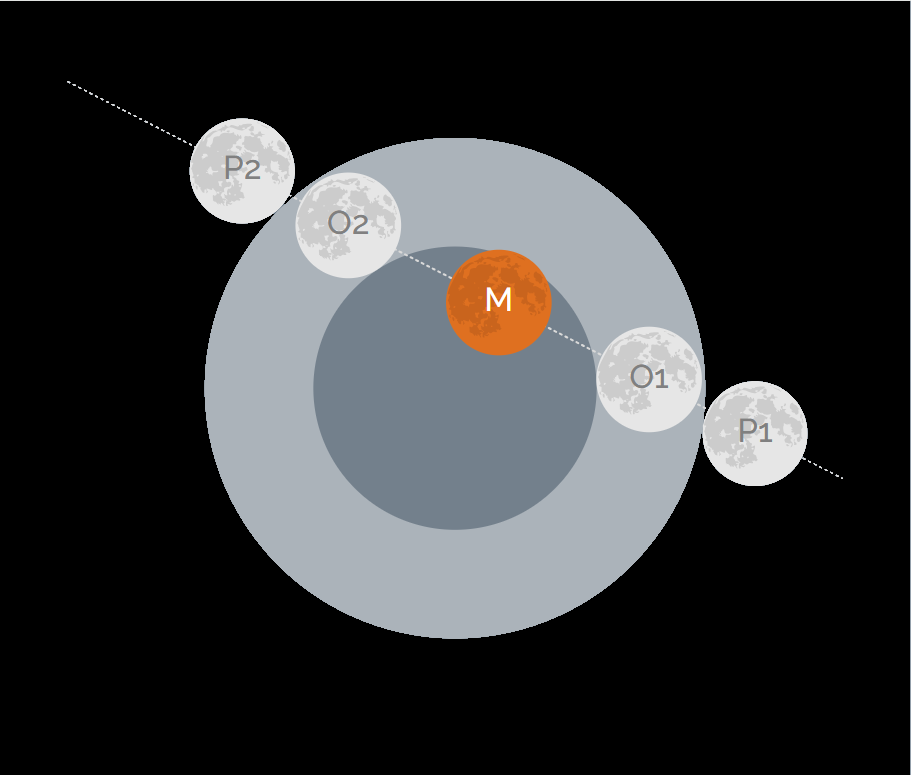
| Eclipse phases | Local time |
|---|---|
|
Penumbral entry (P1) |
02:23 |
|
Umbral entry (O1) |
03:33 |
|
Greatest eclipse (M) |
05:12 |
|
Umbral exit (O2) |
06:52 |
|
Penumbral exit (P2) |
08:01 |
| Eclipse data |
|---|
| Magnitude = 0.93 |
| Umbral radius = 0.68417° |
| Penumbral radius = 1.21171° |
| Partial phase duration = 03:18 |
| Penumbral phase duration = 05:37 |
| UT1 − TT = −69.42 s |