




Report on the Ramadan Lunar Crescent for the Hijri Year 1447
1. Astronomical Data for the Ramadan Crescent of 1447 AH
1.1 Central Conjunction:
The observation of the Ramadan crescent will take place after sunset on Tuesday, 29 Sha'ban 1447 AH, corresponding to February 17, 2026. According to astronomical calculations, the central conjunction between the Sun, Moon, and Earth—which is the moment known as the astronomical birth of the crescent—will occur on Tuesday, February 17, 2026, at exactly 1:01 PM Tunis time (i.e., 12:01 PM GMT). This conjunction represents the temporal point at which the new lunar cycle begins, marking the astronomical start of the new lunar month.
1.2 Position of the Moon at Sunset on Tuesday, February 17, 2026, Corresponding to 29 Sha'ban 1447 AH (Conjunction Day)
In Tunisia:
The Moon will remain in the sky for between 6 and 8 minutes after sunset on Tuesday, February 17, 2026, across all Tunisian cities. It will be in the constellation of Al-Khidra, reaching its highest point above the horizon at about 0.67 degrees from Tataouine in the south, with a central angle between the Moon and the Sun of approximately 2.7 degrees.
The age of the Ramadan crescent at sunset on February 17, 2026, will be about 5 hours and 1 minute only in Tunis. Although the crescent will be present in the sky after sunset, it will be very close to the horizon, reaching a height of 0.43 degrees and an apparent height of about 0.95 degrees in Tunis. The duration of its presence above the horizon will be very short, estimated at about 7 minutes, which is the time the crescent remains visible above the horizon after sunset. These conditions make its sighting extremely difficult, especially in the presence of potential weather factors such as dust or clouds that may obstruct visibility.
- Crescent Visibility Criterion: The crescent can be sighted if the following conditions are met:
- Conjunction occurs before sunset.
- The Moon's altitude at sunset is greater than or equal to 5 degrees.
- The central angle between the Sun and Moon at sunset is greater than or equal to 8 degrees.
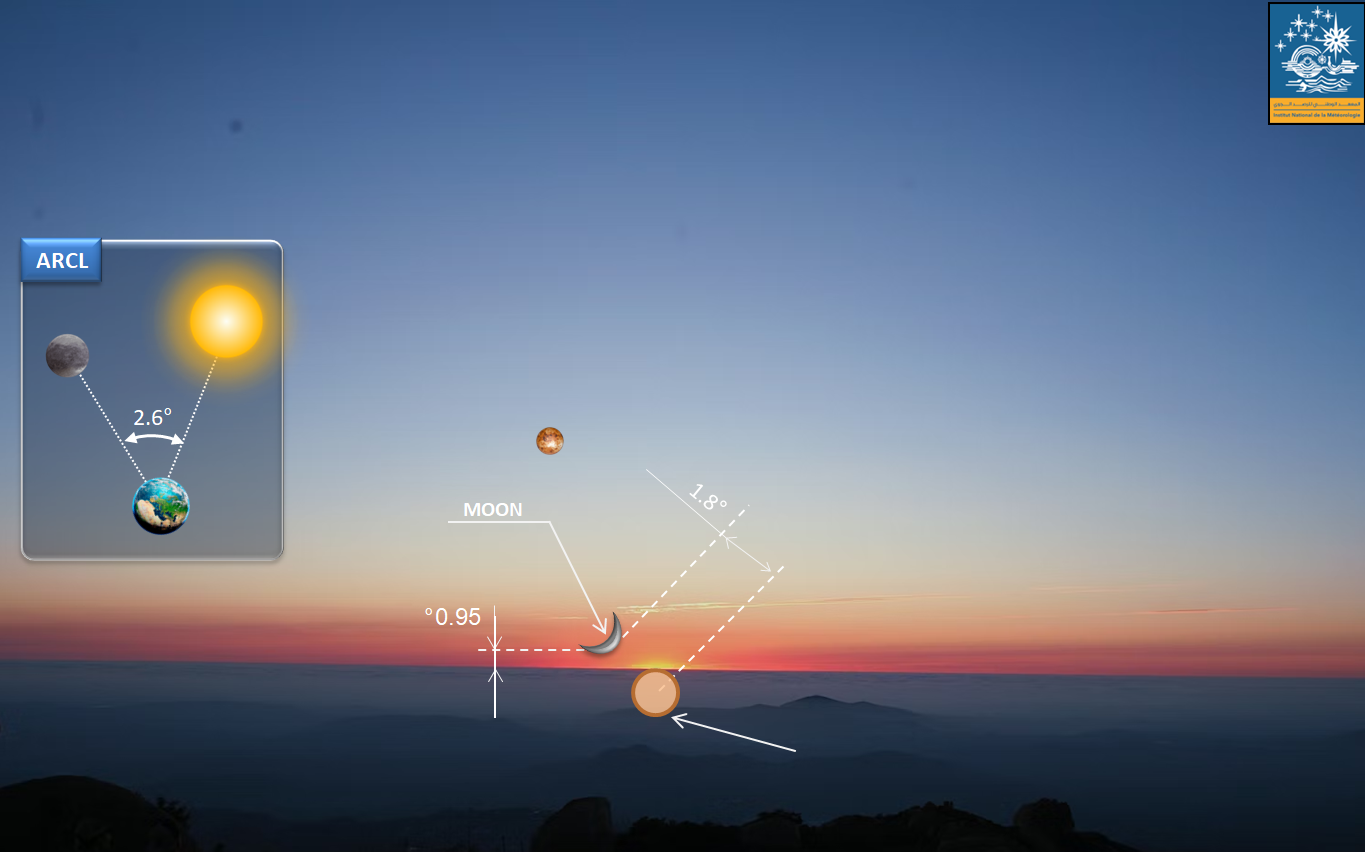
Image 1: Position of the Moon on the western horizon in Tunis at sunset on Tuesday, February 17, 2026, corresponding to 29 Sha'ban 1447 AH.
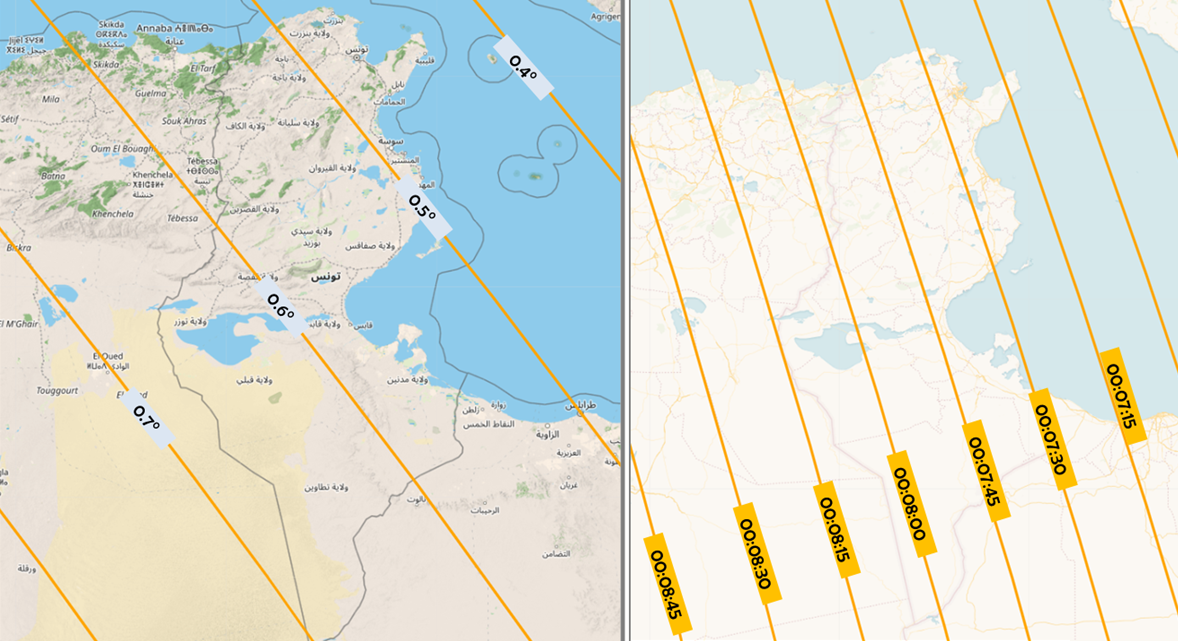
Images 2 and 3: The map on the right (Image 2) illustrates the duration of the crescent's visibility. This map shows the distribution of the duration of the Ramadan crescent's presence after sunset on Tuesday, February 17, 2026, across various parts of Tunisia. The duration is the time the crescent remains above the horizon after sunset and before the Moon sets. This factor is one of the most important astronomical indicators determining the possibility of sighting the crescent with the naked eye or using a telescope. As the map shows, the duration of the crescent's presence in Tunisia ranges between 7 and 8 minutes, reflecting a slight variation in the Moon's position relative to the observer. The map on the left (Image 3) depicts the Moon's altitude above the horizon at sunset, without accounting for refraction, which may raise the crescent apparently by a few arc minutes. Altitude is the angle formed by the line connecting the observer's position to the crescent with the horizon level, measured in degrees. This angle provides an idea of how high the crescent is above the horizon at the moment of sunset, a key factor in sighting the crescent. According to the data, the crescent's altitude above the horizon in Tunisia ranges between 0.4 and 0.7 degrees.
In Islamic Countries:
For Arab and Islamic countries (Image 4), the Moon will remain after sunset on Tuesday, 29 Sha'ban 1447 AH, in all Arab and Islamic countries for varying durations, with a maximum of 12 minutes in Dakar, where the Moon reaches its highest altitude above the horizon at 1.9 degrees and an angle of about 3.7 degrees. In other Arab and Islamic countries, the crescent will remain for a short period after sunset. However, the Moon remains very close to the horizon in these countries, making its altitude extremely low. For example, in Cairo, the altitude reaches only 0.07 degrees; in Mecca, 0.14 degrees; in Istanbul, 0.34 degrees; and in Sana'a, 0.16 degrees.
These low altitudes do not meet the accepted astronomical conditions for sighting the crescent after sunset, which require an altitude of at least 5 degrees to ensure visibility. Additionally, the central elongation between the Sun and Moon is very weak, reaching a maximum of 3.7 degrees in Dakar (Senegal), while the minimum for possible visibility is about 8 degrees. This means the crescent will be very thin and invisible in all Arab and Islamic countries.
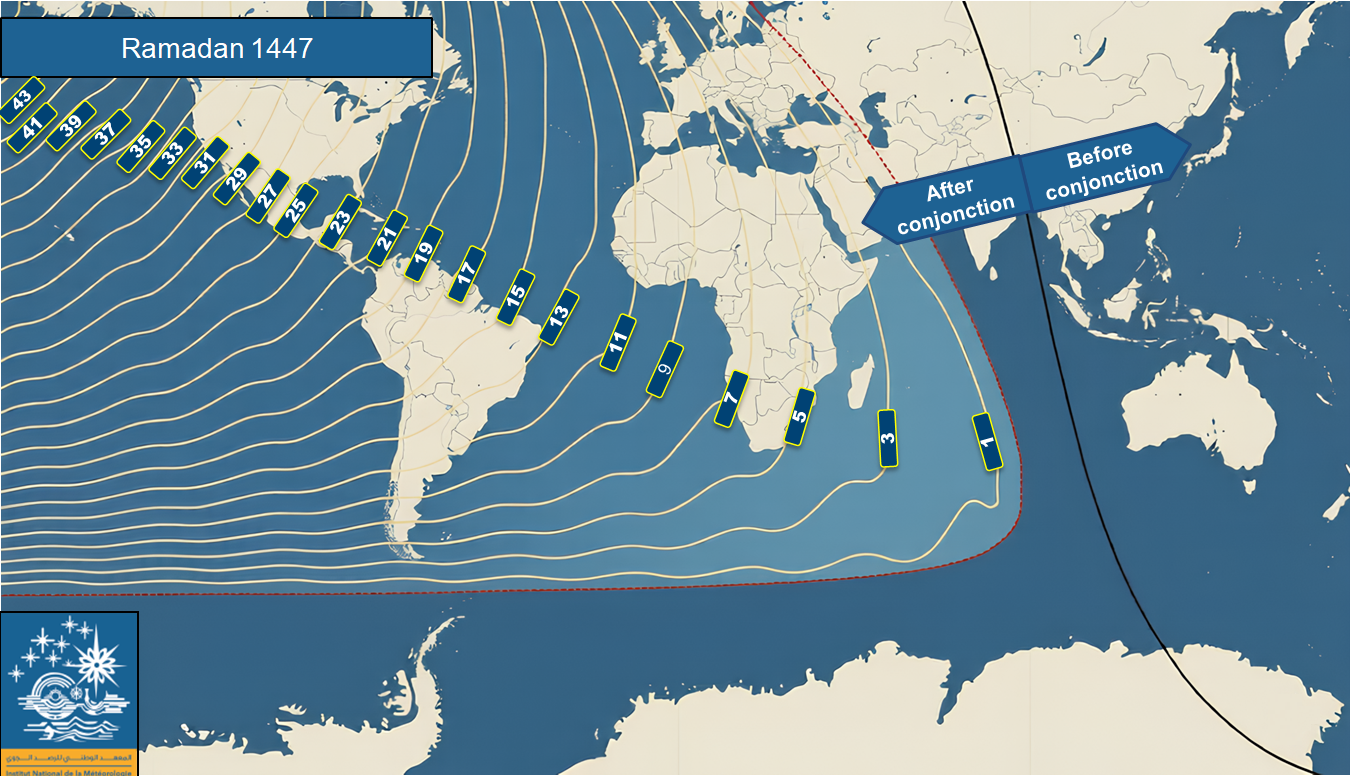
Image 4: Map of isochrones of the Moon's duration in minutes after sunset on Tuesday, February 17, 2026—corresponding to 29 Sha'ban 1447 AH—across the world. The map shows the duration of the Ramadan crescent in various parts of the world, with the Moon remaining visible in Arab countries for between 1 and 12 minutes.
2. Possibility of Sighting the Crescent
Based on astronomical calculations, the astronomical data for the crescent improve gradually as we move westward, where the crescent's age and relative altitude above the horizon increase. However, these values remain below the accepted standards for achieving visual sighting, defined as an altitude of no less than 5 degrees and a central elongation of no less than 8 degrees at sunset. Although the altitude may reach relatively higher levels in some western regions like North America, it remains insufficient to guarantee widespread visibility. This gradual improvement is due to Earth's rotation and local time differences, which grant the crescent additional time. Based on the totality of these astronomical data, the Ramadan crescent cannot be sighted after sunset on Tuesday, February 17, 2026, anywhere in the world, including Arab and Islamic countries and others. Visibility becomes possible on Wednesday, February 18, 2026, starting from 4:44 AM local time in the Republic of Tunisia, corresponding to 03:44 GMT, beginning in the eastern Pacific, such as the Hawaiian Islands, before gradually expanding westward across continents. This is confirmed by the Institute's astronomical maps, which show potential visibility areas and indicate that the following day will be more suitable for sighting due to the increased age and altitude of the crescent above the horizon.
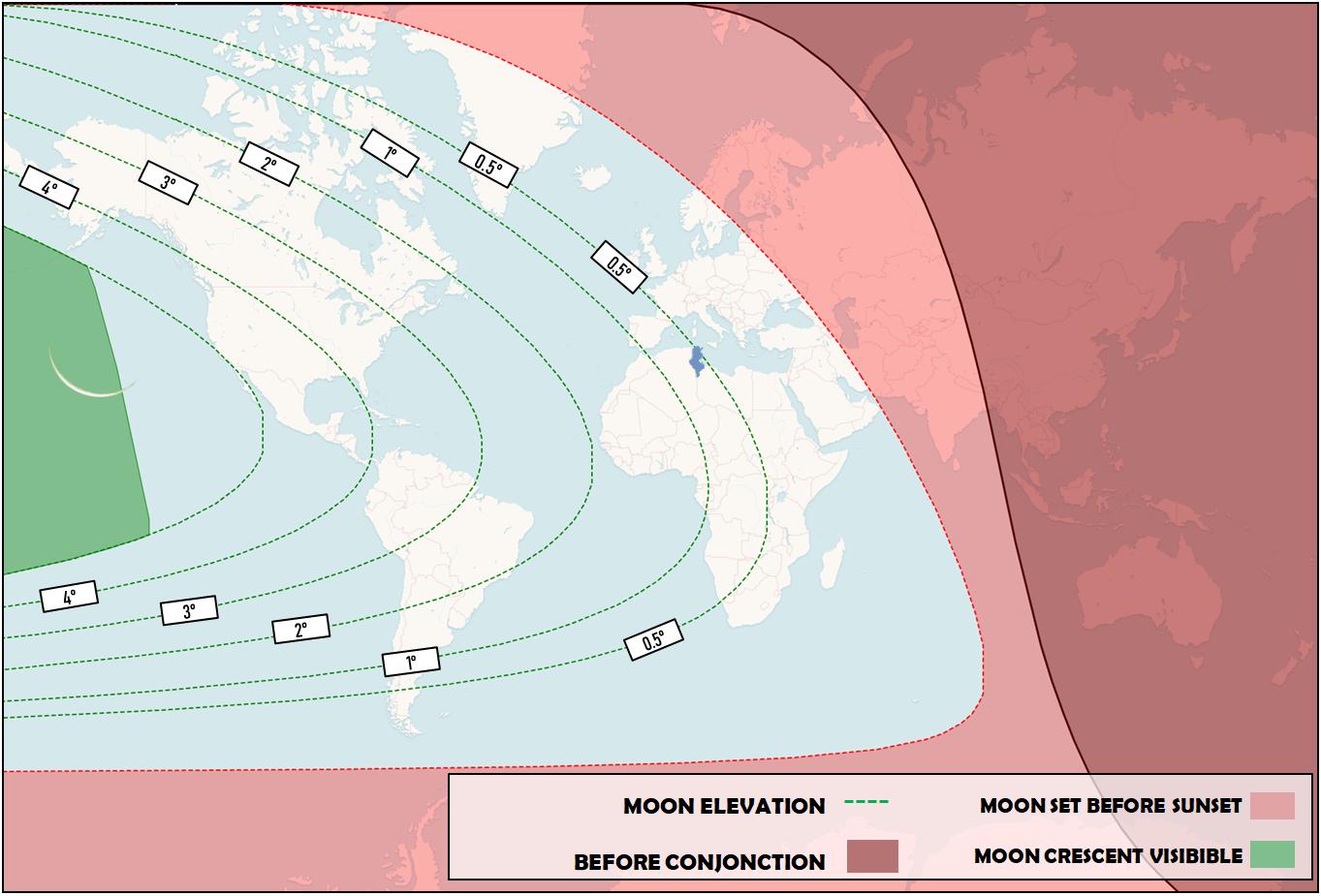
Image 5: Map of the possibility of sighting the Ramadan crescent for 1447 AH after sunset on Tuesday, February 17, 2026, across the world, along with astronomical data on the crescent's age in hours and its altitude in degrees.
Glossary:
Moon's Duration: The time period between sunset and the Moon's set (negative if the Moon sets before sunset).
Moon's Age: The time elapsed from the conjunction to sunset.
Moon's Altitude: The degree of the Moon's elevation relative to the horizon (if the Moon sets before sunset, altitude = ****).
Moon's Deviation: The difference between the direction of the Sun and the Moon.
Angle: The angular distance between the centers of the Sun and Moon.
Crescent Thickness: The illuminated proportion of the Moon's surface.